We often hear that land reforms were the foundation of East Asia’s economic rise. But what if that’s only part of the story? Some recent research suggests that breaking up large landholdings may not have been the real driver of higher yields. So, what actually worked? And what does this mean for India?
How Asia Works
I have been reading How Asia Works by Joe Studwell. Suffice to say that my mind is blown. As someone who is familiar with the contribution of the manufacturing sector in the growth stories of South Korea, Taiwan and Japan, I learnt how much agriculture and land reforms aided in the structural transformation.
Land reforms were critical to kick start development in these economies. In the first half of the 20th century, majority of the population (nearly three fourths) was engaged in agriculture. It was an important driver for the economy and therefore an increase in yield was crucial. The markets however, prioritised tenancy profits which did not help maximise agricultural yield. This was because the land owners could increase rent as they fancied as the supply of land was limited. There was no incentive for either the owners or the tenants to invest in the land.
The land reforms introduced tried to alter this by:
- Redistribution, ownership and ceiling: Fixing a ceiling on the amount of land one can own and redistributing the land to the tillers.
- Support infrastructure: Providing scaffolding through rural credit, marketing institutions, agronomy training and other support services.
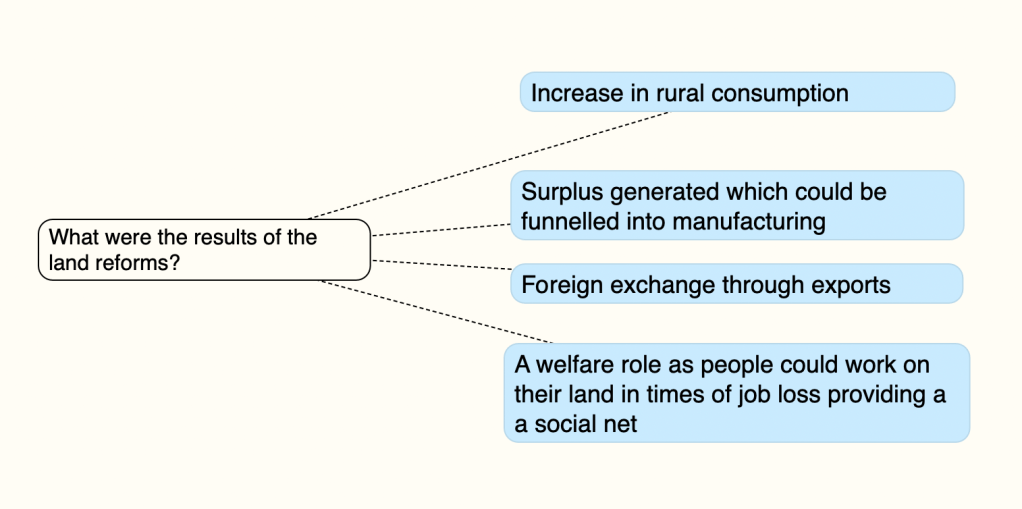
To be clear, the yield increase was due not only to redistribution but also to the various support activities the state provided.
Joe Studwell then explains the key lessons from each of the successful countries in East Asia and the ones where land reforms failed.
Success stories: First of all, in all of the countries where land reforms were a success, what fundamentally worked was a gardening approach to agriculture (labour intensive, small scale and maximum yield per unit of land), which helped increase yield.
Japan, South Korea and Taiwan imposed a 3-hectare ownership limit, but their implementation varied. Japan allowed local tenant and owner-farmer committees to manage the process, compensating landlords with 30-year bonds at 3.6% interest, while ensuring land did not revert to tenancy. South Korea had poor compensation for landlords, a centrally managed process with little farmer input, and delayed rural infrastructure improvements that later boosted yields. Taiwan compensated landlords with 2.5 years’ average crop value, mostly in low-yield bonds, and enabled tenants to purchase land in instalments over ten years.
Countries where land reforms failed (despite the wealth of natural endowments, perhaps even more than the North-East Asian economies): At the heart of this failure, Joe Studwell says, is the elites were co-opted by the colonial rulers, before and after independence which affected their ability to think clearly about national development.
In the Philippines, land reforms failed due to elite resistance and loophole-ridden policies, with minimal government support for infrastructure—leaving NGOs to fill the gap for poor farmers. Indonesia’s reforms were similarly ineffective, as land reform committees were dominated by landlords, ensuring minimal redistribution, and rich peasants remained unaffected. In Malaysia, while British-era rubber plantations received strong infrastructure support, small farmers were neglected, and elite capture undermined tenant security and input distribution efforts. Thailand’s land reforms led to almost no redistribution, with the government providing only basic drainage infrastructure, as low rice yields were offset by abundant cultivable land.
What are the key lessons?
- Land reforms can help unlock growth in agriculture only if supported by institutional and support infrastructure such credit, agronomy training, marketing support, better roads etc.
- The gardening approach works best in early-stage agrarian economies, but as wages rise and labor moves to industry, larger mechanised farms become necessary.
- Elite capture is the biggest threat to land reforms—when the powerful control implementation, redistribution fails.
- Not all crops benefit from smallholder farming. Some crops are more labour-intensive, while others need economies of scale.
Challenges to land redistribution
Recent research by Oliver Kim and Jen-Kuan Wang challenges the idea that Taiwan’s land reforms directly increased yields. Their study breaks Taiwan’s land reform into three phases: rent caps (1949), redistribution of Japanese land (1951), and breaking up large estates (1953). They found that yield increases mostly came from relaxed crop choice in Phase 2, not from the final redistribution. In fact, Phase 3 may have made farming less viable by shrinking farm sizes too much. Instead, Taiwan’s state-led interventions in high-yield seeds and fertilizers played a bigger role in boosting output. This raises an important question: did land reforms really drive Taiwan’s agricultural success, or was it the state’s scientific and technical support?
What does this mean for India?
- Beyond land size, support systems are key: Despite various land sizes, it is critical to provide support in the form of agronomy skilling, input and marketing support, cold-storage infrastructure, educating about export competitiveness and restrictions.
- Different crop, different needs: There are definitely lower bounds of land ownership where cultivation becomes economically unviable for certain types of crops. So the question is: for which types of crops does the large-scale vs. small scale farming make sense? What are the limits where there are diminishing returns?
- Integrating technological advances and agronomy training are crucial: It is extremely important to understanding agronomy for engaging with this topic. Which crops are more likely to have pest attacks and in which season? Which crops are likely to require more attention in terms of weeding, irrigation and less amenable to mechanisation? I saw this video where the founders of Bharat Agri argue that one can make upto $120,000. Most of their interventions focus on taking the scientific advances in the field of agronomy close to farmers.
- Need for benchmarking exercises: It is also worthwhile examining the yield per capita of various crops across various parts of India and internationally to study the relationship between land ownership patterns and yield.
In this context, it is worth examining, what lessons can be drawn from Doubling Farmers’ Income (DFI) programme and past farm law debates? Something for me to dig into a bit deeper.
 PRIYA VEDAVALLI
Leave a comment